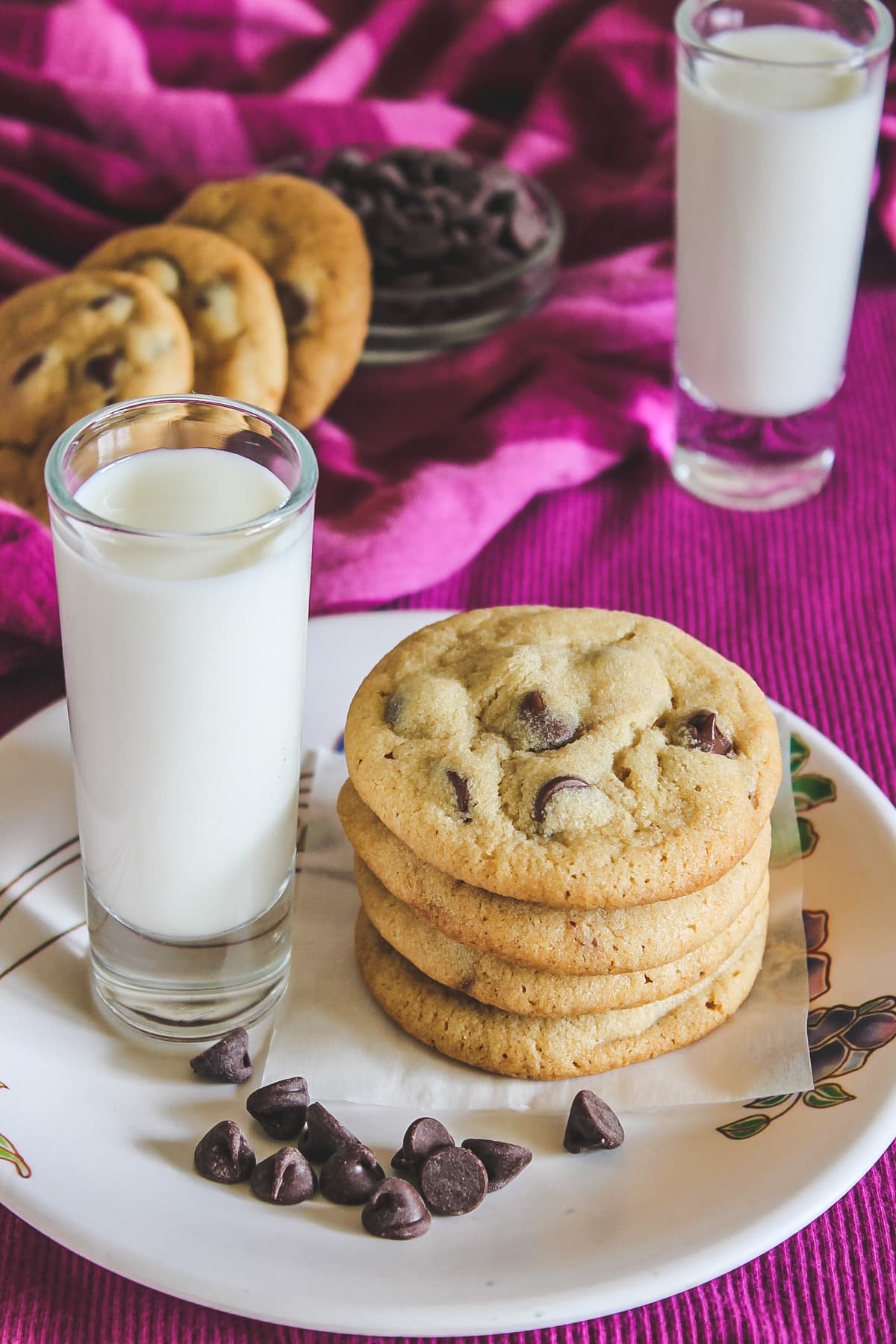
Eggless chocolate chip cookies are a delicious homemade treat for anyone who wants soft, chewy, buttery cookies without using eggs or condensed milk. They are easy to prepare with everyday baking ingredients, making them a practical choice for beginners, families, students, and anyone who wants to enjoy freshly baked cookies at home.
Many people believe that eggs and condensed milk are essential for making good cookies. However, you can make flavorful chocolate chip cookies without either ingredient. The secret is using the right balance of butter, sugar, flour, and moisture, along with a suitable method for mixing and baking the dough.
This eggless chocolate chip cookies recipe without condensed milk creates cookies with lightly crisp edges, soft centers, and plenty of chocolate chips in every bite. You can prepare the dough with common pantry ingredients and bake it in a conventional oven. With a few adjustments, the recipe can also be adapted for different sweetness levels, chocolate varieties, and dietary preferences.
Whether you are preparing an afternoon snack, making treats for children, or looking for an easy homemade dessert, this detailed guide will help you make reliable results.
What Are Eggless Chocolate Chip Cookies?
Eggless chocolate chip cookies are cookies prepared without eggs while retaining the familiar flavor and texture of traditional chocolate chip cookies. They usually contain flour, butter, sugar, chocolate chips, a leavening agent, and a small amount of milk or another suitable liquid.
Eggs typically provide moisture, structure, and binding in cookie dough. When eggs are removed, the other ingredients must provide enough moisture and help the dough hold together. Butter contributes richness, sugar supports browning and texture, and a carefully measured amount of milk helps the flour form a workable dough.
Condensed milk is sometimes used in eggless baking because it adds sweetness, moisture, and richness. However, it is not necessary for this recipe. Ordinary milk provides enough moisture when combined with butter and the other ingredients, while regular granulated and brown sugar create the sweetness and texture.
The result is a simple cookie that tastes rich and chocolatey without requiring specialized ingredients.
Why Make Cookies Without Eggs or Condensed Milk?
There are several reasons to prepare chocolate chip cookies without eggs or condensed milk.
1. Suitable for Egg-Free Baking
Some people avoid eggs for personal, dietary, or religious reasons. Others simply prefer recipes that do not require eggs because they are not always available at home.
An eggless cookie recipe offers a convenient alternative without sacrificing the familiar chocolate chip cookie experience.
However, if you are baking for someone with an egg allergy, check the labels on chocolate chips and other packaged ingredients for possible cross-contact warnings.
2. No Need for Condensed Milk
Sweetened condensed milk is thick, concentrated milk with added sugar. Although it works in many desserts, it can make cookie dough excessively sweet or alter its moisture balance if used incorrectly.
This recipe uses ordinary milk in a much smaller quantity. You can make the dough without buying a separate can of condensed milk or figuring out how to use the leftovers.
3. Made With Everyday Ingredients
Most of the ingredients are commonly available in home kitchens. You generally need flour, butter, sugar, milk, vanilla, baking soda, salt, and chocolate chips.
You do not need a stand mixer, special egg replacer, or complicated baking equipment.
4. Easy to Customize
The basic dough can be adapted to your taste. You can use dark chocolate chips, milk chocolate chunks, chopped chocolate bars, walnuts, or a small amount of cinnamon.
You can also make the cookies smaller for lunchboxes or larger for a bakery-style dessert.
5. Convenient for Small Batches
You can divide the dough and bake only a few cookies when you want a fresh snack. The remaining dough can be stored safely in the refrigerator or freezer for later baking.
Eggless Chocolate Chip Cookies Without Condensed Milk: Recipe Overview

Preparation time
15–20 minutes
Baking time
10–14 minutes per batch
Optional chilling time
30 minutes for thicker cookies
Yield
Approximately 16–20 medium cookies
Difficulty
Beginner-friendly
The exact yield depends on the size of each portion. Smaller cookies bake faster, while larger cookies need additional baking time.
Ingredients for Eggless Chocolate Chip Cookies
The following quantities make a balanced dough with buttery flavor, a soft center, and chocolate throughout.
Dry Ingredients
| Ingredient | Quantity | Purpose |
|---|---|---|
| All-purpose flour | 1½ cups (about 190 g) | Provides structure |
| Baking soda | ½ teaspoon | Helps the cookies spread and brown |
| Salt | ¼ teaspoon | Balances sweetness |
| Cornstarch | 1 teaspoon, optional | Helps create a tender texture |
Cornstarch is optional, but it can make the finished cookies more delicate. If you do not have it, leave it out rather than replacing it with an equal amount of an unrelated ingredient.
Wet Ingredients
| Ingredient | Quantity | Purpose |
|---|---|---|
| Unsalted butter | ½ cup (113 g) | Adds richness and tenderness |
| Brown sugar | ½ cup (about 100 g) | Supports moisture and chewiness |
| Granulated white sugar | ¼ cup (about 50 g) | Adds sweetness and helps the edges crisp |
| Milk | 2–3 tablespoons | Supplies moisture and helps bind the dough |
| Vanilla extract | 1 teaspoon | Adds flavor |
Use softened butter rather than fully melted butter for the mixing method in this recipe. Softened butter should yield slightly when pressed but should not look oily or liquid.
If you only have salted butter, you can use it and reduce or omit the added salt.
Chocolate Ingredients
| Ingredient | Quantity | Purpose |
|---|---|---|
| Chocolate chips | ¾ cup (about 130 g) | Main chocolate flavor |
| Extra chocolate chips | 1–2 tablespoons, optional | For decorating the tops |
Semi-sweet chocolate chips provide a balanced flavor. Dark chocolate chips are useful if you prefer less sweetness, while milk chocolate chips create a sweeter cookie.
You can also chop a chocolate bar into small pieces. Chopped chocolate often creates irregular pockets of melted chocolate throughout the cookie.
Equipment You Will Need
You do not need professional bakery equipment for this recipe. Prepare the following items before mixing the dough:
- A large mixing bowl
- A medium bowl for dry ingredients
- A whisk or fork
- A sturdy spoon or hand mixer
- Measuring cups and spoons, or a kitchen scale
- A baking tray
- Parchment paper or a suitable reusable baking liner
- A cookie scoop or tablespoon
- A cooling rack
A kitchen scale is especially helpful because flour can become compacted in measuring cups. Too much flour can make eggless cookies dry, crumbly, or cakey.
If you are using measuring cups, spoon flour into the cup and level the top instead of pressing the flour down.
Step-by-Step Instructions
Follow these steps for dependable results. Measure the ingredients before beginning, and allow the oven to preheat fully.
Step 1: Preheat the Oven
Preheat your oven to 350°F (175°C).
Allow enough time for the oven to reach the correct temperature before placing the cookies inside. An oven that is too cool may cause the butter to melt before the dough sets, producing excessive spreading.
Line a baking tray with parchment paper. If you are baking multiple batches, prepare an additional tray or allow the first tray to cool before reusing it.
Step 2: Combine the Dry Ingredients
Add the all-purpose flour, baking soda, salt, and optional cornstarch to a medium bowl.
Whisk until the ingredients are evenly distributed. This helps prevent concentrated pockets of baking soda or salt in the finished cookies.
Set the bowl aside.
There is no need to sift the flour unless it contains lumps. If the flour is visibly clumped, sift it before measuring.
Step 3: Cream the Butter and Sugars
Place the softened butter in a large mixing bowl.
Add the brown sugar and granulated sugar. Beat with a hand mixer on medium speed or mix firmly with a spoon until the mixture becomes creamy and relatively uniform.
This usually takes about two to three minutes with a hand mixer, depending on the softness of the butter.
The mixture does not need to become extremely fluffy. The goal is to combine the butter and sugar evenly while retaining a texture suitable for cookies.
If the butter is too cold, it will be difficult to mix. If it is too warm, the mixture may become greasy and the cookies may spread too much.
Step 4: Add the Vanilla and Milk
Add one teaspoon of vanilla extract and two tablespoons of milk to the butter mixture.
Mix until combined.
The mixture may look slightly less smooth than a traditional egg-based cookie batter. That is normal because milk and butter do not combine in exactly the same way as eggs and butter.
Do not add all the milk immediately if your flour is particularly fine or your butter is very soft. You can add the remaining tablespoon later if the dough needs more moisture.
Step 5: Add the Dry Ingredients
Add the flour mixture to the wet ingredients in two or three additions.
Stir gently after each addition. Stop mixing as soon as the flour is mostly incorporated and a soft dough forms.
Overmixing can encourage a tougher texture. Eggless dough does not need prolonged beating once the flour has been added.
At this stage, the dough should be soft enough to shape but not so wet that it behaves like cake batter.
If it appears extremely sticky, avoid immediately adding large amounts of flour. First, let it rest for five minutes. Flour absorbs moisture gradually, and the consistency may improve.
If the dough is dry and breaks apart when pressed, add milk one teaspoon at a time.
Step 6: Fold in the Chocolate Chips
Add approximately three-quarters of a cup of chocolate chips.
Fold them into the dough using a spoon or spatula until they are distributed evenly.
Reserve a small handful if you want visible chocolate chips on the tops of the cookies.
Try not to crush the chips while mixing. Keeping them intact gives the finished cookies a more attractive appearance and distinct chocolate pockets.
Step 7: Chill the Dough if Needed
For thicker cookies, cover the bowl and refrigerate the dough for about 30 minutes.
Chilling firms the butter and allows the flour to absorb some moisture. This helps control spreading and can improve the texture.
If your kitchen is cool and the dough already feels firm, you may be able to skip chilling. However, chilling is particularly useful in warm weather or when the butter has softened more than intended.
Do not leave the dough uncovered in the refrigerator because it may absorb other food odors or develop a dry surface.
Step 8: Portion the Dough
Scoop the dough into portions approximately one to one-and-a-half tablespoons in size.
Roll each portion gently into a ball, then place it on the lined baking tray. Leave approximately two inches between the portions to allow for spreading.
Press a few reserved chocolate chips onto the top of each dough ball.
For a thicker cookie, keep the dough portions relatively tall instead of flattening them heavily. For a thinner cookie, gently press each ball into a small disc.
Try to keep the portions similar in size so that they bake evenly.
Step 9: Bake the Cookies
Place the tray on the middle rack of the preheated oven.
Bake for approximately 10–14 minutes, depending on cookie size and your oven.
Look for these signs:
- The edges are lightly golden.
- The centers appear set around the outside but remain soft.
- The tops no longer look wet or raw.
- The chocolate chips are softened or slightly melted.
Do not wait until the entire cookie becomes dark brown. Cookies continue to firm up after leaving the oven, and excessive baking can make eggless cookies hard.
If you are using a new oven or making the recipe for the first time, check a small batch at the ten-minute mark.
Step 10: Let the Cookies Set on the Tray
Remove the tray from the oven and place it on a heat-safe surface.
Allow the cookies to rest on the tray for five to ten minutes. They may look delicate immediately after baking, but they become more stable as they cool.
Do not try to move them too quickly, particularly if you want soft centers. Eggless cookies can be more fragile while hot because they do not contain the structural proteins found in eggs.
After the cookies have firmed, transfer them carefully to a cooling rack.
Step 11: Cool and Serve
Allow the cookies to cool for another 10–15 minutes before serving.
The chocolate will gradually set, and the texture will become easier to handle. If you prefer a warm, gooey center, enjoy one while it is still slightly warm after its initial setting period.
Serve the cookies with milk, tea, coffee, or your favorite non-alcoholic drink.
Tips for Soft and Chewy Eggless Chocolate Chip Cookies
The ingredient list is simple, but small changes can significantly affect the final texture.
Use Brown Sugar for Moisture
Brown sugar contains molasses, which contributes flavor and helps retain moisture. Using a combination of brown sugar and white sugar creates a useful balance between chewiness and crispness.
If you use only white sugar, the cookies may spread and crisp differently. They can still be delicious, but the texture will not be identical.
For a softer result, keep the brown sugar portion higher than the white sugar portion.
Measure the Flour Carefully
Excess flour is one of the most common causes of dry cookies.
If you scoop directly into a flour container, you may pack more flour into the measuring cup than the recipe requires. Spoon the flour into the cup and level it, or weigh approximately 190 grams.
If the dough is slightly soft, chill it before adding more flour. Adding unnecessary flour can produce dense cookies.
Avoid Overbaking
Eggless chocolate chip cookies often appear softer in the center when they first come out of the oven. This is desirable.
If you wait until the centers feel firm while the cookies are still in the oven, they may become dry after cooling.
Remove the cookies when the edges are lightly golden and the centers are mostly set but still soft.
Chill Dough in Warm Weather
Butter softens quickly in a warm kitchen. If your dough feels oily or difficult to shape, refrigerate it before baking.
Chilling is also useful when you want a thicker cookie with less spreading.
Choose Good-Quality Chocolate
Chocolate is one of the main flavors in this recipe, so its quality matters.
Semi-sweet chocolate chips are a dependable choice. Chopped baking chocolate can provide larger melted pockets, while dark chocolate offers a less sweet contrast to the cookie dough.
Check the packaging if you need the cookies to be free from egg ingredients or specific allergens.
Do Not Overmix After Adding Flour
Once the dry ingredients are added, stir only until the dough comes together.
Long mixing can develop more gluten in the flour, which may make the cookies tougher than intended.
Let the Cookies Cool Properly
Cooling is part of the baking process. Fresh cookies need a few minutes to develop enough structure to be moved without breaking.
Use a thin spatula to lift them gently after they have rested on the tray.
How to Make Eggless Cookies Thick and Bakery-Style
If you prefer thick cookies with soft centers, make a few adjustments to the basic method.
First, chill the dough for 30–60 minutes. Cold dough generally spreads more slowly in the oven.
Second, keep each portion relatively tall. Instead of rolling the dough into perfectly round balls and flattening them, shape slightly taller mounds.
Third, avoid placing dough on a hot baking tray. A warm tray can soften the butter before the cookies enter the oven, increasing spreading.
Fourth, do not use more milk than necessary. Extra liquid can change the consistency and lead to a flatter cookie.
Finally, check your oven temperature. If the oven is cooler than expected, the butter may melt before the cookies develop enough structure.
For a bakery-style finish, press a few chocolate chips into the tops immediately after baking, while the surface is still soft. This creates a neat, chocolate-rich appearance.
How to Make the Cookies Crispier
Some people prefer crisp cookies rather than soft and chewy ones. You can adjust this recipe to suit that preference.
Use slightly smaller dough portions and flatten them gently before baking. Bake until the edges become more deeply golden, watching closely to prevent burning.
You can also increase the proportion of white sugar slightly while reducing the brown sugar by the same amount. This changes the moisture balance and may produce a crisper texture.
After baking, allow the cookies to cool completely on a rack. Store them only when fully cool, since trapped steam can soften their texture.
Remember that eggless cookies can become dry if they are baked for too long. Aim for crisp edges rather than an overly dark center.
How to Make the Cookies Softer
For softer cookies, use the specified brown sugar, measure the flour accurately, and avoid baking the cookies until they are uniformly brown.
A small amount of cornstarch can help produce a tender crumb. You should also allow the dough to rest briefly if it seems slightly dry before deciding whether it needs additional milk.
Do not store the cookies uncovered for extended periods. Exposure to air gradually changes their texture and can make them stale.
Once fully cooled, place them in an airtight container.
Common Mistakes to Avoid
Mistake 1: Adding Too Much Milk
Milk helps bind the dough, but excessive liquid can make it too loose. The cookies may spread too much or develop an unusual texture.
Begin with two tablespoons and add more only if needed.
Mistake 2: Using Melted Butter Without Adjusting the Method
This recipe is designed for softened butter. Melted butter changes the dough structure and may lead to thinner cookies.
If you intentionally use melted butter, allow it to cool before mixing and expect to need chilling time. The texture may differ from the original recipe.
Mistake 3: Skipping the Oven Preheating Step
An oven that has not reached the correct temperature may bake the cookies unevenly.
Always preheat the oven before putting the tray inside.
Mistake 4: Placing Cookies Too Close Together
Cookies spread as the butter melts. If they are crowded, they may merge into one another.
Leave enough room around each dough portion.
Mistake 5: Moving the Cookies While They Are Hot
Freshly baked cookies are delicate. Lifting them immediately can cause them to break.
Let them rest on the tray before transferring them to a cooling rack.
Mistake 6: Replacing Ingredients Without Considering Their Function
Flour, sugar, butter, milk, and baking soda each play a specific role. Replacing several ingredients at once can make it difficult to predict the result.
If you want to experiment, change one ingredient at a time and record the results.
Troubleshooting: Why Did My Eggless Cookies Fail?
Use this guide to identify the likely cause and improve your next batch.
| Problem | Possible cause | Solution |
|---|---|---|
| Cookies spread too much | Warm butter, warm tray, or dough too soft | Chill the dough and use a cool tray |
| Cookies are dry | Too much flour or excessive baking | Measure flour accurately and shorten baking time |
| Cookies are hard | Overbaking or insufficient moisture | Remove them when the centers are still soft |
| Cookies crumble easily | Dough is too dry or cookies were moved too soon | Add milk gradually if needed and cool on the tray |
| Cookies are cakey | Too much flour or an altered ingredient ratio | Weigh the flour and follow the quantities closely |
| Cookies are pale | Oven temperature too low or baking time too short | Verify the oven temperature and check the edges |
| Cookies taste bitter | Too much baking soda | Measure baking soda carefully |
| Chocolate chips burn | Excessively high heat or very exposed chocolate | Use the middle rack and avoid overbaking |
Why Are My Cookies Flat?
Flat cookies usually result from butter that is too warm, a dough that contains too much moisture, or a tray that is already hot.
Chill the dough for 30 minutes and bake a test cookie. If it still spreads excessively, check your flour measurement and oven temperature before changing the recipe substantially.
Why Are My Cookies Hard After Cooling?
The most likely cause is overbaking. Cookies continue to firm as they cool, so removing them only when they feel completely firm in the oven can produce a hard result.
Another possibility is excess flour. Use a scale when possible and avoid compressing flour in measuring cups.
Why Is My Dough Crumbly?
Without eggs, the dough depends on the butter and milk to hold together. If the flour is excessive or the milk quantity is too low for your ingredients, the dough may crumble.
Press a small portion between your fingers. If it does not hold together, add milk one teaspoon at a time and mix gently until the dough becomes workable.
Why Do My Cookies Taste Too Sweet?
Chocolate chips can contribute substantial sweetness, especially when using milk chocolate.
Try semi-sweet or dark chocolate chips next time. You can also reduce the white sugar slightly, but avoid making large reductions at the beginning because sugar affects spread, moisture, and browning as well as sweetness.
Ingredient Substitutions and Variations
The basic recipe is flexible, but each substitution may change the finished texture. For best results, keep the main proportions consistent until you understand how a particular ingredient behaves.
1. Eggless Dark Chocolate Chip Cookies
Replace the semi-sweet chocolate chips with dark chocolate chips or chopped dark chocolate.
This version has a stronger chocolate flavor and may taste less sweet. It pairs well with a little extra vanilla, although no additional vanilla is required.
2. Eggless Milk Chocolate Cookies
Use milk chocolate chips if you prefer a sweeter, creamier flavor.
Because milk chocolate is sweeter than many dark chocolate varieties, you may wish to reduce the granulated sugar by one tablespoon.
3. Chocolate Chunk Cookies
Replace the chocolate chips with roughly chopped chocolate.
Different-sized pieces create varied pockets of melted chocolate. Reserve several larger pieces to press into the tops of the dough portions before baking.
4. Walnut Chocolate Chip Cookies
Add approximately ¼ cup of chopped walnuts.
Toast the walnuts lightly before using them if you want a deeper nutty flavor. Allow them to cool completely before adding them to the dough.
Check for nut allergies before serving these cookies to others.
5. Double Chocolate Eggless Cookies
For a chocolate-flavored dough, replace about two tablespoons of flour with unsweetened cocoa powder.
Mix the cocoa powder thoroughly with the remaining dry ingredients. Cocoa powder absorbs moisture, so the dough may need a small additional amount of milk.
The resulting cookies will be darker, richer, and more intensely chocolatey.
6. Eggless Cinnamon Chocolate Chip Cookies
Add approximately ¼ teaspoon of ground cinnamon to the dry ingredients.
Cinnamon gives the cookies a warm flavor that works especially well with dark chocolate. Start with a small amount so it does not overpower the chocolate.
7. Eggless Peanut Butter Chocolate Chip Cookies
You can replace a small portion of the butter with smooth peanut butter, but this changes the fat and moisture balance.
Start by replacing two tablespoons of butter with two tablespoons of peanut butter. The dough may become thicker, and the finished cookies will have a noticeable peanut flavor.
Do not make a full butter replacement without testing the recipe because the texture can change significantly.
8. Eggless Cookies With White Chocolate Chips
Replace some or all of the semi-sweet chocolate chips with white chocolate chips.
White chocolate produces a sweeter cookie with a creamy flavor. Pairing white chocolate with a small amount of chopped dried cranberry can add a pleasant tart contrast.
9. Eggless Cookies With Raisins
If you do not have chocolate chips, you can replace them with raisins or a mixture of raisins and chopped nuts.
The result will taste different from a traditional chocolate chip cookie but will still make a convenient homemade snack.
10. Smaller Lunchbox Cookies
Divide the dough into smaller portions of approximately one tablespoon each.
Begin checking them earlier than the standard baking time because smaller cookies bake faster. Let them cool completely before packing them into a lunchbox.
Can You Make Eggless Chocolate Chip Cookies Without a Mixer?
Yes. A mixer is convenient but not necessary.
Use a sturdy spoon or spatula to combine the softened butter and sugars. Press the mixture against the side of the bowl to break up lumps and distribute the ingredients.
Once the mixture is reasonably creamy, add the vanilla and milk. Stir in the dry ingredients gradually, then fold in the chocolate chips.
Manual mixing may take a little longer, but it works well for a small batch.
Avoid using butter straight from the refrigerator because it will be difficult to mix by hand. Allow it to soften naturally before starting.
Can You Make These Cookies Without an Oven?
This particular recipe is designed for conventional oven baking, but a stovetop method may be possible with suitable equipment.
A heavy-bottomed pot with a lid can sometimes be used as a makeshift baking chamber, provided the setup can be used safely and the heat is controlled carefully. Results will differ from oven baking, and the cookies may brown unevenly.
An air fryer may also work if the appliance’s manufacturer permits baking cookies. Use a suitable heat-safe tray or liner, leave space for spreading, and begin checking the cookies early because air fryers can cook more quickly than conventional ovens.
Do not place parchment paper loosely in a preheated air fryer, where airflow can lift it toward the heating element. Follow the appliance’s instructions for safe use.
For the most consistent results, use the oven temperature and baking method provided in the main recipe.
How to Store Eggless Chocolate Chip Cookies
Proper storage helps preserve flavor and texture.
At Room Temperature
Allow the cookies to cool completely. Place them in an airtight container and store them in a cool, dry location away from direct sunlight.
For best quality, aim to enjoy them within about three to five days. Actual freshness depends on humidity, ingredient handling, and the container used.
Do not seal warm cookies in a container. Trapped steam can create condensation and make them soggy.
In the Refrigerator
Refrigeration is usually unnecessary for plain cookies that have been baked thoroughly and handled properly. It can also make them firm.
If you choose to refrigerate them, keep them in a tightly sealed container and allow them to return toward room temperature before serving.
In the Freezer
For longer storage, freeze the cooled cookies in a freezer-safe container or bag.
Separate layers with parchment paper to prevent sticking. Label the container with the date and try to use the cookies within about two to three months for good quality.
Thaw the cookies at room temperature while covered or gently warm them in an oven if you prefer a freshly baked texture.
How to Freeze Eggless Cookie Dough
Freezing the dough is useful when you want freshly baked cookies without preparing a new batch each time.
Method 1: Freeze Individual Dough Portions
- Prepare the dough according to the recipe.
- Scoop it into individual portions.
- Place the portions on a parchment-lined tray.
- Freeze until firm.
- Transfer the frozen portions to a freezer-safe bag or container.
- Label the container with the recipe name and date.
When you want cookies, place the portions on a lined baking tray and bake them from frozen if your oven and recipe allow. They will generally require extra baking time, so check their appearance rather than relying only on the original timing.
Method 2: Refrigerate the Dough
If you plan to bake the cookies within a short period, cover the dough tightly and refrigerate it.
For best results, use refrigerated dough within about two to three days. Keep it cold, and discard it if it develops an unusual smell, appearance, or other signs of spoilage.
If the dough becomes very firm, allow it to sit briefly at room temperature until it is workable. Do not leave it out for an extended period.
How to Serve Eggless Chocolate Chip Cookies
These cookies are versatile enough for everyday snacks and special occasions.
With Milk
A glass of cold milk is a classic pairing. The mild flavor of milk balances the sweetness of the chocolate and butter.
With Tea or Coffee
Serve the cookies with black tea, milk tea, or coffee for an afternoon snack.
If the cookies are very sweet, unsweetened tea or coffee can create a pleasant balance.
With Ice Cream
Place a scoop of vanilla ice cream between two completely cooled cookies for an easy dessert sandwich.
Press gently and serve immediately. For easier handling, freeze the assembled sandwiches briefly before serving.
As a Dessert Plate
Serve two cookies with fresh fruit and a small scoop of ice cream. This is an easy way to turn a simple homemade recipe into a more complete dessert.
For Parties and Gatherings
Bake smaller cookies and arrange them on a serving plate. A mixture of dark chocolate, milk chocolate, and white chocolate versions creates variety without requiring entirely different recipes.
If you are serving guests with dietary restrictions, clearly identify the ingredients and potential allergens.
Are Eggless Chocolate Chip Cookies Vegetarian?
This recipe contains no eggs, but whether the finished cookies meet a particular vegetarian standard depends on the ingredients you choose.
Butter and ordinary milk are dairy products. Some chocolate products may also contain ingredients that do not meet every dietary preference.
Check product labels if you follow a strict vegetarian diet.
Eggless does not automatically mean vegan or allergen-free. To make a vegan version, you would need suitable plant-based butter and plant-based milk, as well as chocolate chips that meet your requirements. The results may differ from the original recipe.
Can You Make This Recipe Dairy-Free?
Yes, you can experiment with a dairy-free version by using a plant-based butter substitute and unsweetened plant milk.
Choose a baking product intended to replace butter rather than a watery spread. Different plant-based products contain different amounts of fat and water, so the dough may behave differently.
Oat milk and soy milk are possible options, provided they suit your dietary needs. Add the liquid gradually and use only enough to bring the dough together.
Make sure the chocolate chips are also dairy-free if you need the entire recipe to avoid dairy.
How to Make the Recipe More Budget-Friendly
Homemade cookies can be economical when you plan the ingredients carefully.
Buy flour, sugar, and chocolate in quantities that suit your expected baking needs. Store ingredients correctly to prevent waste.
If chocolate chips are expensive, use a baking chocolate bar chopped into small pieces. Compare the price per gram rather than assuming a particular package is the cheapest option.
You can also make smaller cookies, which increases the number of portions from one batch. Smaller cookies still deliver the same basic flavor, although they need less baking time.
Avoid purchasing special ingredients that are unnecessary for the recipe. Cornstarch is optional, and a hand mixer is not required.
Food Safety and Allergy Considerations
Eggless cookies are useful when avoiding eggs, but the recipe still contains other ingredients that may cause allergies or dietary concerns.
- Wheat: All-purpose flour contains gluten.
- Milk: Butter and milk contain dairy.
- Soy: Some chocolate chips contain soy lecithin.
- Nuts: Optional additions such as walnuts or peanut butter introduce nut allergens.
Read packaging labels carefully and use clean utensils and surfaces. If you are preparing cookies for someone with a severe allergy, consider the risk of cross-contact from shared equipment and packaged ingredients.
Do not taste raw cookie dough. Flour can carry harmful bacteria, and removing eggs does not make uncooked dough safe to eat. Bake the cookies fully and follow safe food-handling practices.
Frequently Asked Questions
1. Can I Make Chocolate Chip Cookies Without Eggs and Condensed Milk?
Yes. This recipe uses butter, brown sugar, white sugar, milk, flour, baking soda, vanilla, and chocolate chips. The butter and a small quantity of milk help the dough come together without eggs or condensed milk.
2. What Can I Use Instead of Eggs in Chocolate Chip Cookies?
For this particular recipe, you do not need a separate egg replacer. The combination of butter, sugar, and a measured amount of milk creates a workable dough.
Other recipes may use mashed banana, applesauce, yogurt, or commercial egg replacers, but these ingredients change the flavor and moisture balance. They are not direct one-to-one replacements in every cookie recipe.
3. Can I Use Only White Sugar?
Yes, but the texture will change. Brown sugar contributes moisture and a mild caramel flavor, while white sugar can support a crisper texture.
If you use only white sugar, expect a different result rather than an exact match for the original recipe.
4. Can I Use Only Brown Sugar?
You can experiment with using only brown sugar. The cookies may have a deeper flavor and a softer texture, depending on the type of brown sugar.
Because sugar affects more than sweetness, changing the proportions can also affect spreading and browning.
5. Why Do These Cookies Need Milk?
Milk provides moisture and helps bind the flour and other ingredients into a workable dough.
The amount required can vary slightly with flour type, measuring accuracy, and butter softness. Begin with two tablespoons and add more gradually if needed.
6. Can I Skip the Cornstarch?
Yes. Cornstarch is optional. The cookies will still work without it, although the texture may be slightly different.
Do not replace the missing cornstarch with an equal quantity of additional flour unless you are intentionally adjusting the recipe.
7. How Long Should I Bake Eggless Chocolate Chip Cookies?
At 350°F (175°C), medium cookies generally take about 10–14 minutes.
The exact time depends on their size, your oven, and the baking tray. Look for lightly golden edges and centers that are mostly set but still soft.
8. Should I Chill the Cookie Dough?
Chilling is recommended if you want thicker cookies or if the dough feels very soft. Refrigerate it for approximately 30 minutes before shaping and baking.
If the dough is already firm and your kitchen is cool, chilling may be less important.
9. Can I Make the Dough a Day Ahead?
Yes. Cover the dough tightly and refrigerate it. For best quality, bake it within about two to three days.
If the dough becomes firm in the refrigerator, allow it to soften slightly before portioning.
10. Can I Freeze the Baked Cookies?
Yes. Cool them completely and store them in a freezer-safe container or bag. Separate layers with parchment paper to make removal easier.
For good quality, try to use them within two to three months.
11. Can I Use Oil Instead of Butter?
Oil can be used in some cookie recipes, but it does not behave exactly like butter. Butter contributes flavor and contains both fat and water, while different oils have different properties.
A direct substitution may create flatter, greasier, or differently textured cookies. For the most reliable result, use butter or a baking substitute designed to replace it.
12. Why Are My Cookies Not Spreading?
The dough may be too cold, contain too much flour, or have insufficient moisture. The oven temperature may also be higher than expected, causing the edges to set before much spreading occurs.
Check the flour measurement and allow very cold dough to sit briefly before baking. Make one test cookie before adjusting the entire batch.
13. Why Are My Cookies Too Soft in the Middle?
Cookies naturally remain soft immediately after baking. Allow them to rest on the tray for five to ten minutes so they can firm up.
If the centers remain visibly wet or raw after cooling, the cookies may need more baking time. Adjust the timing for your oven and cookie size.
14. Can I Make These Cookies Without Vanilla Extract?
Yes. Vanilla adds flavor but is not essential to the dough’s structure.
You can omit it or use a suitable vanilla alternative. The cookies may have a simpler flavor, but the recipe should still work.
15. Can I Reduce the Chocolate Chips?
Yes. You can reduce the quantity to half a cup if you prefer fewer chocolate chips or want to lower the ingredient cost.
Reducing the chocolate will not usually prevent the dough from working, although the finished cookies will contain less chocolate in each bite.
16. Are These Cookies Suitable for Children?
They can be a suitable homemade snack for children who can safely eat the ingredients. Adjust the portion size to suit the child and consider the child’s age and chewing ability.
Check for allergies, especially to wheat, dairy, soy, and any optional nuts.
17. Can I Make Larger Bakery-Style Cookies?
Yes. Use larger portions of dough and leave more space between them. Larger cookies generally require more baking time, so check the edges and centers carefully.
Chilling the dough can help maintain thickness. Avoid increasing the oven temperature simply to speed up baking.
18. Can I Use Whole-Wheat Flour?
You can replace some of the all-purpose flour with whole-wheat flour, but the texture will change. Whole-wheat flour absorbs moisture differently and may create a denser cookie.
For a first experiment, replace only about one-quarter of the all-purpose flour and check the dough consistency before baking.
19. How Do I Know When the Cookies Are Done?
The edges should be lightly golden, and the outer portion of each cookie should look set. The centers can remain soft, but they should not look like liquid batter.
Let the cookies rest on the tray before judging their final texture.
20. Can I Make This Recipe Gluten-Free?
A gluten-free version may be possible with a suitable gluten-free flour blend formulated for baking. Different blends absorb moisture differently, so the texture may not match the original recipe exactly.
Follow the flour blend’s instructions and test a small batch first. If the cookies are for someone with celiac disease or a serious gluten sensitivity, check labels and prevent cross-contact.
Final Thoughts
Eggless chocolate chip cookies without condensed milk are an easy and satisfying homemade dessert. With ordinary ingredients, careful measurements, and a few simple techniques, you can make cookies that have lightly crisp edges, soft centers, and plenty of chocolate flavor.
The most important details are to measure the flour accurately, use softened rather than melted butter, add milk gradually, and avoid overbaking. Chilling the dough can also help if you prefer thicker cookies or are baking in a warm kitchen.
Once you understand the basic method, you can customize the recipe with dark chocolate, walnuts, cinnamon, or other favorite additions. You can also prepare the dough ahead of time and freeze individual portions for convenient future baking.
Whether you are making a small afternoon treat or a batch for family and friends, this eggless chocolate chip cookies recipe offers a practical way to enjoy homemade cookies without eggs or condensed milk.